Winter holidays: New Year and Orthodox Christmas
January: New Year, the central holiday
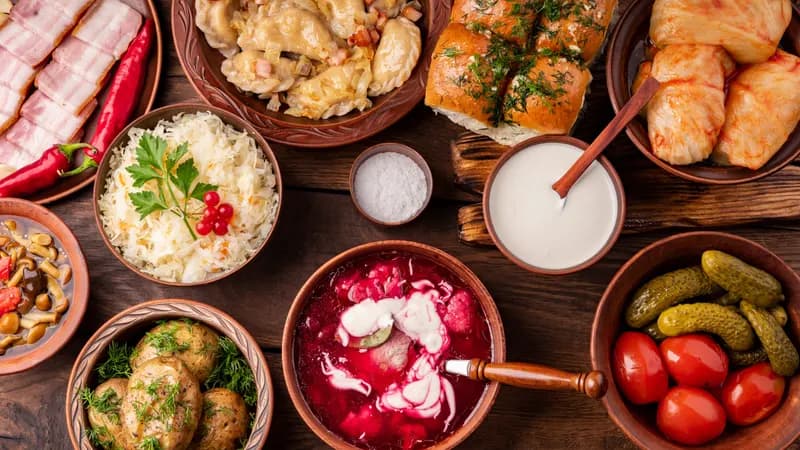
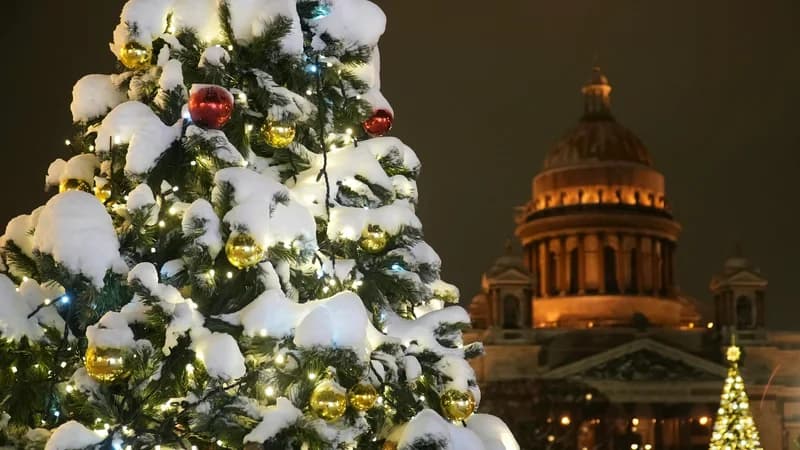
New Year (Новый год, Novy God) is the most important holiday in the Russian calendar — far more than Christmas. The period from December 31 to January 8 is officially non-working, and the entire country stops. Tree (yolka), midnight family meal, TV with the presidential address at 23:55, Soviet champagne (Sovetskoye shampanskoye), Olivier salad and herring under fur coat (selyodka pod shuboy) are the unmissable markers.
It is Ded Moroz (Grandfather Frost) accompanied by his granddaughter Snegurochka who brings gifts, placed under the tree on the morning of January 1. No equivalent of Santa Claus or December 24 as a peak moment.
nearly all of Russia pauses from December 31 to January 8. Administrative work impossible, banks closed, many restaurants on brunch mode or closed.
January 7: Orthodox Christmas (Рождество)
The Russian Orthodox Church follows the Julian calendar: Christmas falls on January 7, thirteen days after Catholic Christmas. A religious rather than commercial holiday, marked by the Orthodox midnight mass at the Cathedral of Christ the Savior (broadcast live), a traditionally lean meal the evening before (Sochelnik), and a family meal on the 7th. January 7 is an official holiday.
Mid-February to early March: Maslenitsa
Maslenitsa (Масленица) is the "pancake week" preceding the Great Orthodox Lent. The date varies, usually between late February and early March. For seven days, people eat blini (with butter, sour cream, caviar, salmon, jam) which symbolize the spring sun and the exit from winter.
Each day of the week has a name and specific use: Monday (encounter), Tuesday (games), Wednesday (gluttony), Thursday (revelry), Friday (visiting the mother-in-law), Saturday (gathering at the sister-in-law's), Sunday (Forgiveness — you ask forgiveness from all close ones before entering Lent).
Sunday ends with the burning of the Maslenitsa effigy, a straw mannequin incinerated to symbolize the end of winter. Public ceremonies at VDNKh, Gorky Park and Manezh Square in Moscow; spectacular to watch.
Late February to March: Defender's Day and Women's Day
February 23: Defender of the Fatherland Day
Formerly Red Army Day, February 23 has effectively become Men's Day. All women give gifts to the men in their circle: father, brother, husband, son, colleagues. Symmetrical to March 8. Public holiday.
March 8: International Women's Day
Major date, public holiday and deeply rooted in Russian culture — far more than in the West. Every man brings flowers and gifts to the women in his circle: spouses, mothers, sisters, colleagues, assistants, neighbors. Florists triple their annual sales that day. Restaurants packed, prices inflated, hotels full — book ahead.
April or early May: Orthodox Easter
Orthodox Easter (Пасха, Paskha) follows the Julian calendar and rarely falls on the same Sunday as Catholic Easter. The most important religious holiday of the year. Central tradition: the Saturday evening vigil in a church, during which the paskha (cylindrical fresh-cheese cake with raisins and candied fruit) and kulich (column-shaped glazed brioche) are blessed. At midnight, the priest proclaims "Христос Воскресе" ("Christ is Risen"), to which the congregation answers "Воистину Воскресе" ("Truly He is Risen").
Painted eggs (traditionally red, or wax-decorated) are exchanged between close ones. The Sunday Easter meal breaks forty days of Lent.
May 1 and 9: holiday and Victory Day
May 1 (Labor Day) is a holiday, bridged with May 9. May 9 is Victory Day (День Победы) over Nazi Germany in 1945, a major patriotic holiday. Military parade on Red Square in Moscow, "Immortal Regiment" parade (citizens carrying portraits of their ancestors who fought), fireworks. Many Russians wear a black-and-orange Saint George ribbon on their lapel.
In practice this is a two-week bridge: very little operates between May 1 and 10 for many companies. Excellent tourist period but administratively blocked.
Summer and autumn national holidays: Russia Day and National Unity
June 12: Russia Day
National holiday instituted in 1992, marking Russia's 1990 declaration of sovereignty. Public holiday, modest parades, free concerts in major cities. Less identity-charged than May 9 but retains a strong official character.
November 4: Day of National Unity
Public holiday since 2005, commemorating Moscow's liberation from Polish forces in 1612. Symbolically replaced November 7 (October Revolution anniversary, removed from the calendar). More political than popular but the day is non-working.
Complete public holiday calendar
| Date | Holiday | Days off |
|---|---|---|
| Jan 1-8 | New Year vacation | 8 |
| Jan 7 | Orthodox Christmas | (included) |
| Feb 23 | Defender of the Fatherland | 1 |
| Mar 8 | Women's Day | 1 |
| May 1-2 | Labor Day | 2 |
| May 9 | Victory Day | 1 |
| Jun 12 | Russia Day | 1 |
| Nov 4 | National Unity | 1 |
Total: 15 official public holidays per year, among Europe's most generous. Add the official bridges that can turn a Tuesday holiday into a four-day weekend.
Religious and popular non-public holidays
Several Orthodox or traditional holidays are not non-working but culturally marked:
- January 19: Baptism of Christ (Крещение). Ice baths in blessed water holes (proruby). Spectacular to watch but very cold.
- August 31 / September 1: Day of Knowledge, school start with children in uniform and flowers for teachers. Not a holiday, but city traffic jams guaranteed.
- October 1: Day of the elderly and teachers.
Practical consequences for expats and travelers
- Avoid administrative work between December 28 and January 10, from February 23 to March 8 (two holidays in two weeks), and from May 1 to 10. Processing times double or triple.
- Book well in advance for restaurants and travel on December 31, March 8 and May 9: these are the three absolute peaks of the year.
- Tell your family back home that religious holidays (Christmas, Easter) fall on different dates. You can celebrate two Christmases (Western on December 25, Russian on January 7) — culturally appreciated.
Bottom line
The Russian calendar articulates a strong winter pole (New Year + Orthodox Christmas = 11 days in practice) and a spring pole (May 1 to 10). Maslenitsa and Orthodox Easter are the most important religious holidays culturally, while New Year remains the central secular event. For anyone settling or traveling regularly, anticipating these dates saves weeks of admin time and lets you share moments of rare cultural intensity.