Orthodoxy vs Catholicism: the key differences
The Russian Orthodox Church separated from the Roman Catholic Church at the Great Schism of 1054. A thousand years later, several structural differences remain:
- Julian calendar instead of Gregorian: Christmas falls on January 7, Easter on a different Sunday (usually later). See our Russian holidays calendar guide.
- No pope. The Orthodox Church consists of autocephalous Churches (Russian, Greek, Serbian, etc.) bound by faith but administratively independent. The Patriarch of Moscow and all Russia heads the Russian Church.
- No purgatory in Orthodox theology: only heaven and hell after Judgment.
- The Holy Spirit proceeds from the Father alone (theological Filioque point, historical source of the schism), while Catholics say "from the Father and the Son."
- Married priests allowed (but not bishops, who are monks). There is no universal sacerdotal celibacy.
- Liturgy in Church Slavonic rather than modern Russian for most traditional services.
The architecture of a Russian Orthodox church
Understanding the space helps respect the codes:
- The narthex (entrance): reception area, where candles and icons are bought. Headcoverings purchased here if needed.
- The nave: large central space where the faithful stand for the entire liturgy (benches are rare or reserved for the elderly).
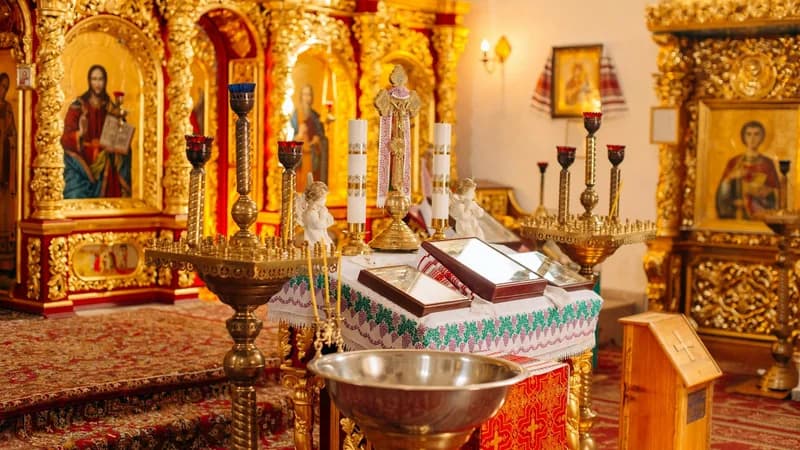
- The iconostasis: carved wooden wall covered with icons that separates the nave from the sanctuary. Three doors: central (royal), north (deacon), south (server).
- The sanctuary: behind the iconostasis, accessible only to clergy.
- The domes: usually five (Christ + 4 evangelists) or three (Trinity), sometimes thirteen (Christ + 12 apostles).
Etiquette to observe on entry
Whether visiting as a tourist or attending a service, several rules apply:
Clothing:
- Women: head covered (scarf, shawl, hood), shoulders covered, skirt below the knee or loose pants. Tight pants or shorts are frowned upon. Many churches provide loaner scarves and skirts at the entrance.
- Men: head uncovered (remove hat, cap), no shorts, short sleeves accepted in summer.
Behavior:
- Phone off or silent. Photos forbidden during services, generally allowed during quiet times unless signs say otherwise.
- Quiet voice in the nave.
- Do not turn your back to the iconostasis: enter and exit moving sideways, without facing away from the sanctuary.
- Do not cross your arms or put your hands behind your back during a service (signals of distance or defiance).
The Orthodox sign of the cross
The Orthodox sign of the cross is made right to left (not left to right as in Catholicism):
- Three fingers joined (thumb + index + middle, symbolizing the Trinity) — ring and pinky folded (the two natures of Christ).
- Forehead ("In the name of the Father").
- Solar plexus ("and of the Son").
- Right shoulder ("and of the Holy Spirit").
- Left shoulder ("Amen").
The sign of the cross is performed on entering and leaving the church, before saluted icons, and at several specific moments of the liturgy. A non-Orthodox visitor is not obliged to do it but may do so respectfully out of politeness.
Kissing the icon
Before an important icon, the ritual gesture is: three bows + sign of the cross between each + kissing the icon on the saint's hand (never on the face). Faithful wait their turn without rushing.
For a non-believing tourist, observing respectfully is enough. No obligation to participate.
Candles: use and meaning
Buying and lighting a candle is a central act of Orthodox devotion. A few practical rules:
- Purchase at the narthex, free price (50-300 RUB usually).
- For the health of the living: candle before the icon of a patron saint or the Mother of God. Wooden boards inscribed "Здоровье".
- For the rest of the deceased: candle on the kanun, a rectangular table with a crucifix usually placed on the left as you enter. Board labeled "Упокой".
- Light your candle from another already lit, never with a lighter.
- Never blow out a candle — the attendant takes care of it.
Icons: meaning and use
The Orthodox icon is not a decorative religious image. It is a prayer support considered as a window to the sacred. A few markers to grasp them:
- Christ Pantocrator: Christ from the bust, holding the Gospel book, right hand raised in blessing. Central icon in every church.
- Mother of God of Vladimir: Mary holding the infant Jesus cheek to cheek, melancholy gaze. The most venerated Marian icon in Russia.
- Rublev's Trinity: three angels around a table, painted by Andrei Rublev around 1410. Absolute reference of Orthodox iconography.
- Saint Nicholas: pointed white beard, miter, Gospel book. The most popular saint in Russia after Christ and the Mother of God.
Icons are not painted; they are said to "be written" — the iconographer is a copyist of models transmitted since the 6th century, not a creative artist in the Western sense.
Liturgical calendar: the twelve great feasts
Beyond Easter (Paskha), Russian Orthodoxy celebrates twelve great feasts spread throughout the year:
- Nativity of the Virgin (Sept 21)
- Exaltation of the Cross (Sept 27)
- Presentation of the Virgin in the Temple (Dec 4)
- Nativity of Christ (Christmas, Jan 7)
- Theophany / Baptism of Christ (Jan 19) — ice baths
- Presentation in the Temple (Feb 15)
- Annunciation (Apr 7)
- Entry into Jerusalem (Palm Sunday)
- Ascension (40 days after Easter)
- Pentecost (50 days after Easter)
- Transfiguration (Aug 19)
- Dormition of the Virgin (Aug 28)
During these feasts, evening liturgies are particularly worth observing as a respectful tourist.
Visiting the main Russian cathedrals
In Moscow:
- Cathedral of Christ the Savior (Kropotkinskaya): rebuilt in 1995, seat of the Patriarch.
- Cathedral of the Dormition at the Kremlin: tsars' coronation site since the 15th century.
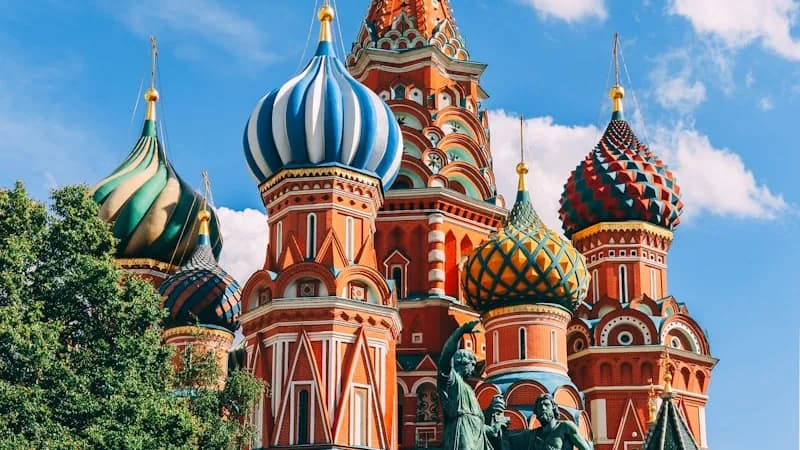
- Saint Basil's Cathedral on Red Square: Russian architectural icon (but rarely used for services).
- Donskoy Monastery and Novodevichy Monastery: remarkable heritage ensembles.
In Saint Petersburg:
- Church of the Savior on Spilled Blood: exceptional mosaics.
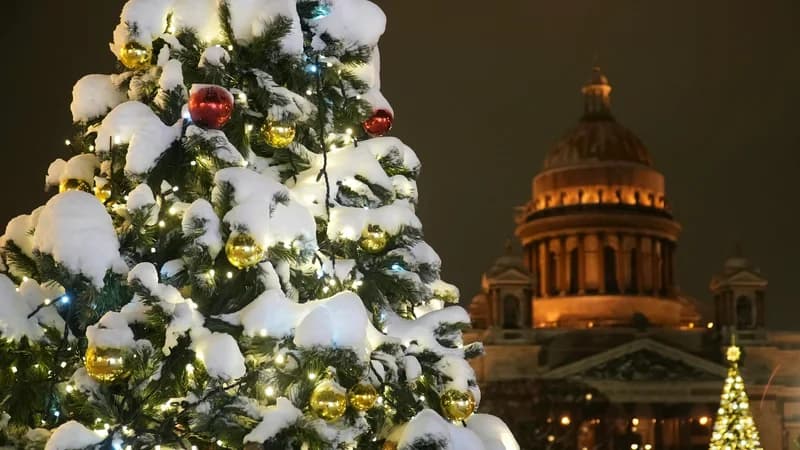
- Saint Isaac's Cathedral: huge gilded dome, panoramic view at the top.
- Kazan Cathedral on Nevsky Prospekt: diocesan seat.
Outside the capitals: Sergiev Posad (Trinity Lavra of Saint Sergius, about 70 km northeast of Moscow) is the spiritual heart of Russian Orthodoxy and deserves a full day.
Bottom line
Russian Orthodoxy is lived as a daily presence: icons in homes, sign of the cross when passing a church, family celebrations for Christmas and Easter. For a Westerner, understanding the minimum codes (dress, sign of the cross right to left, entry etiquette, icon vs painting distinction) opens respectful access to one of the deepest dimensions of Russian culture — without requiring you to share the faith that animates it.