For roughly three weeks each June, the sun barely sets over Saint Petersburg. The sky never fully darkens. A pale, luminous twilight holds from late evening through the early hours, blurring the boundary between day and night and casting the city's canals, palaces, and bridges in a light that photography struggles to capture and memory stubbornly retains. These are the White Nights, Saint Petersburg's most celebrated natural phenomenon and the foundation of its most intense cultural season.
The White Nights transform the city. Residents and visitors pour onto the streets, the bridges open to river traffic in the small hours, concerts and festivals fill every venue, and the normal rhythms of sleep and work yield to something more festive and slightly unhinged. For travellers, it is the single best time to visit Saint Petersburg, provided you book early and accept that sleeping may prove elusive. Our complete Saint Petersburg travel guide covers accommodation, transport, and sights for every season.
The Science Behind the White Nights
Saint Petersburg sits at 59.9 degrees north latitude, roughly level with the southern tip of Greenland and the Alaskan panhandle. At this latitude, the Earth's axial tilt during the summer solstice (around 21 June) prevents the sun from descending more than a few degrees below the horizon. The result is a phenomenon known as civil twilight: the sky retains enough ambient light that artificial illumination is unnecessary, even at the darkest point of the night.
On the solstice itself, Saint Petersburg experiences approximately 18 hours and 50 minutes of daylight, with the remaining hours occupied by twilight bright enough to read a newspaper outdoors. Complete darkness does not occur from late May through mid-July.
The effect is not unique to Saint Petersburg. Helsinki, Stockholm, and Reykjavik experience similar phenomena. But no other city at this latitude combines the White Nights with such a concentrated programme of cultural events, and none matches Saint Petersburg's architectural setting.
When Exactly Are the White Nights?
The White Nights are conventionally dated from 11 June to 2 July, though the nights are noticeably light from late May onward and remain so until mid-July. The peak period, when the twilight is most dramatic, runs from approximately 18 to 28 June, bracketing the summer solstice.
The key dates for 2026:
- 21 June: Summer solstice, the lightest night
- Late June to early July: Peak of White Nights cultural programming
- Last Saturday of June: Scarlet Sails festival (the season's climax)
The Scarlet Sails Festival
The undisputed highlight of the White Nights calendar is Alye Parusa (Scarlet Sails), held on the last Saturday of June. The festival celebrates the end of the school year and the beginning of summer, drawing over a million spectators to the Neva embankments.
The centrepiece is a tall ship with crimson sails gliding along the Neva River at approximately 01:30, accompanied by fireworks, laser shows, and orchestral music broadcast along the embankments. The image references Alexander Grin's 1923 romantic novella Scarlet Sails, in which a young woman awaits a ship with red sails that will carry her to happiness.
The spectacle is free and open to all. Embankment positions fill up from early evening; arriving by 20:00 is advisable for a decent view. The Palace Embankment and Vasilievsky Island's Strelka offer the best vantage points. A preliminary concert programme runs from approximately 22:00, building to the ship's appearance in the early hours.
Practical warnings: The crowds are immense, and the metro closes before the main event begins. Plan your return in advance: walking, pre-booked taxis (surge pricing applies), or simply staying out until the metro reopens at 05:30. Pickpocketing risk increases in the dense crowds; keep valuables secure.
Arrive on Palace Embankment by 20:00 for the Scarlet Sails frigate's 01:30 passage — the metro shuts before the climax, so plan a walking return or pre-book a Yandex Go at surge pricing.
Cultural Events During the White Nights
Stars of the White Nights Festival (Mariinsky Theatre)
The Mariinsky Theatre's annual festival runs from late May through mid-July, presenting opera, ballet, symphonic concerts, and recitals featuring both the Mariinsky's resident companies and international guest artists. The festival is one of the world's premier classical music events.
Tickets range from 1,500 to 12,000 RUB depending on the production and seating. Popular performances (particularly ballet) sell out weeks in advance. Book through the Mariinsky's website (mariinsky.ru), which has a reliable English-language interface.
Palaces at Night
Several of Saint Petersburg's imperial residences offer special evening programmes during the White Nights. The Peterhof fountains are illuminated in a light show on selected evenings (typically Saturdays in June-July), with admission around 1,500-2,500 RUB. The experience of seeing the Grand Cascade lit against a twilight sky is genuinely spectacular.
Open-Air Concerts and Street Performance
Throughout June, the city hosts open-air concerts in parks, squares, and courtyards. Palace Square, the Summer Garden, and the New Holland Island cultural complex all programme events. Many are free or charge modest admission (300-1,000 RUB). The Saint Petersburg Philharmonia also schedules special White Nights concerts.
Bridge Openings
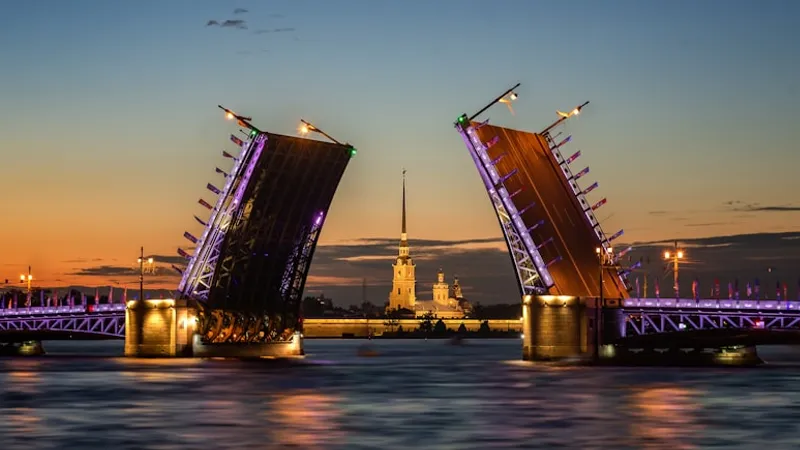
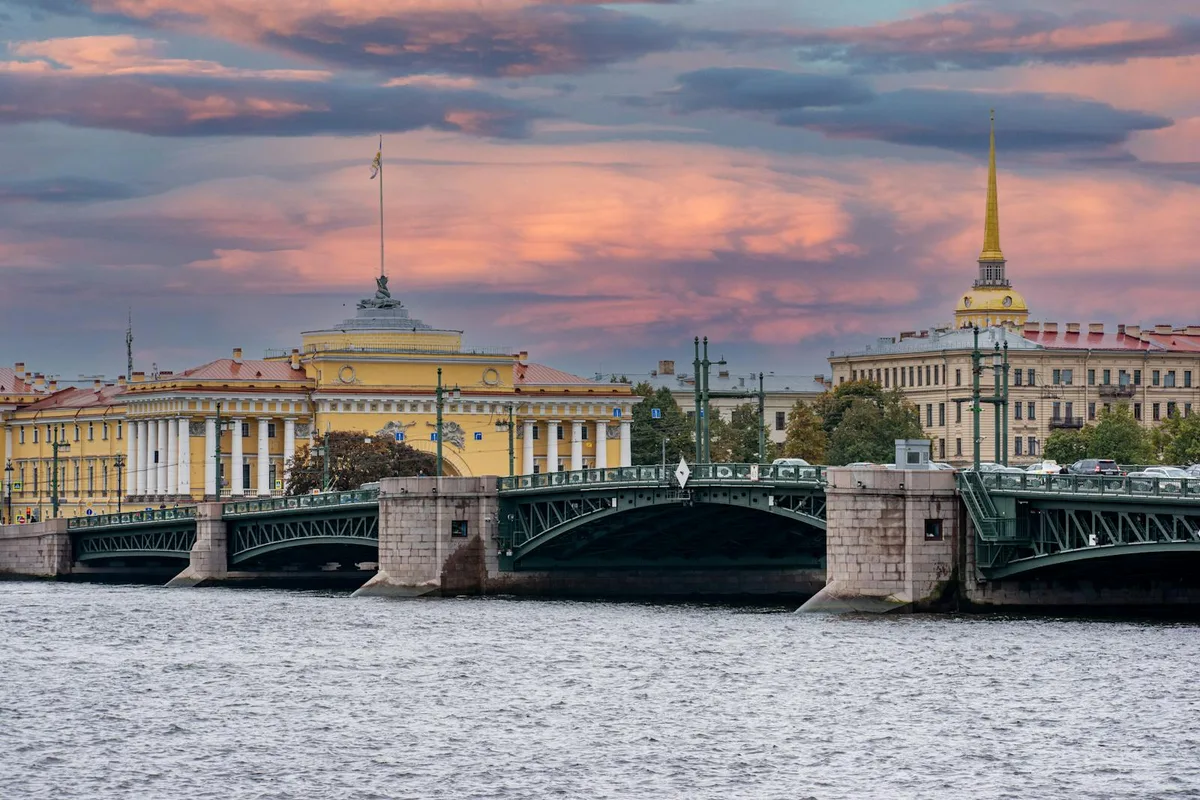
Saint Petersburg's drawbridges open nightly from approximately April to November, and during the White Nights, watching the bridges rise has become a ritual. The Palace Bridge, directly in front of the Hermitage, opens at 01:10 and provides the most dramatic visual. Boat tours specifically timed around bridge openings run throughout the White Nights season (1,000-2,500 RUB for a 60-90 minute tour). Watching the bridges rise from a boat on the Neva, with the lit facades of the Winter Palace and the Peter and Paul Fortress reflected in the water, is one of Saint Petersburg's defining experiences.
Where to Experience the White Nights
Along the Embankments
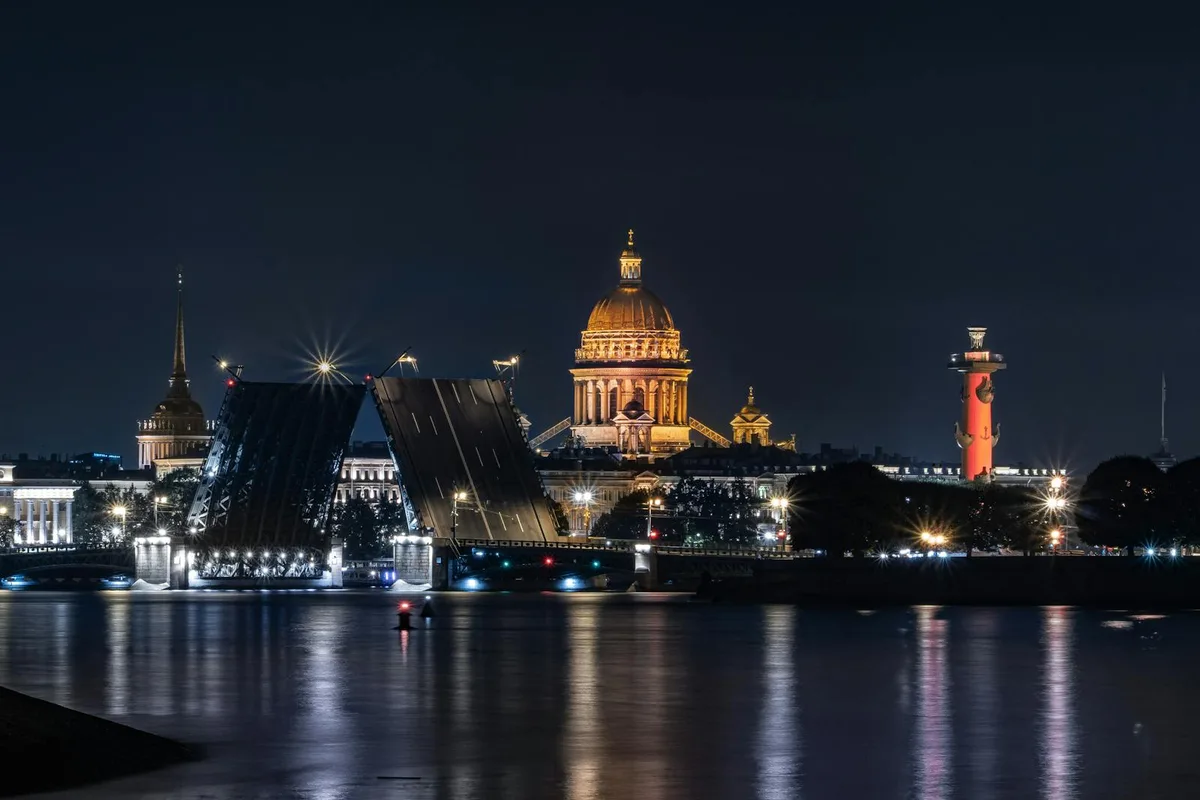
The Neva embankments, from the Admiralty to the Summer Garden, offer the most dramatic White Nights walks. The light reflecting off the water, the facades of the Hermitage and the Academy of Arts, and the distant spire of the Peter and Paul Cathedral create a scene of extraordinary beauty. Walk from Palace Square along the Dvortsovaya Embankment, cross to the Strelka on Vasilievsky Island for panoramic views, then loop back via the Troitsky Bridge.
Rooftops
Saint Petersburg's rooftop culture flourishes during the White Nights. Several companies offer guided rooftop tours (1,500-3,000 RUB) that provide elevated views of the twilight skyline. The legality of some of these operations is ambiguous, and the safety standards vary. Choose established operators with good reviews.
The Summer Garden
Russia's oldest public park, laid out by Peter the Great, is open until late evening in summer. Its marble statues, fountains, and tree-lined alleys take on a particular character in the extended twilight. Free admission.
New Holland Island
This former naval storehouse complex has been converted into a cultural space with restaurants, a park, and exhibition areas. Open until 23:00 in summer, it is an excellent spot for an evening drink during the White Nights. Free entry to the park.
Practical Tips for Visitors
Sleep
The obvious challenge: how do you sleep when it never gets dark? The answer, for many visitors, is that you do not sleep much. If sleep is important to you (and it should be, over a trip of several days), bring a quality sleep mask or ensure your accommodation has blackout curtains. Budget hotels and hostels often lack them; check in advance. Melatonin supplements can help adjust your body's response to the persistent light.
Accommodation
The White Nights are peak tourist season. Hotel prices increase by 30-80% compared to the shoulder season, and availability is limited. Book at least two months in advance, preferably three. A mid-range hotel room that costs 4,000-6,000 RUB per night in April may cost 7,000-10,000 RUB in late June.
Crowds
Central Saint Petersburg is significantly more crowded during the White Nights than at any other time. The Hermitage, Peterhof, and the Church of the Saviour on Spilled Blood all have longer queues. Pre-book museum tickets online wherever possible. Visit major attractions early in the morning (before 11:00) or late in the afternoon (after 16:00) to avoid the worst congestion.
What to Wear
June temperatures average 15-22C, but evenings can be cool (10-14C), and rain is always possible. A light jacket, a waterproof layer, and comfortable walking shoes are essential. The embankments can be breezy, particularly after midnight.
Photography
The White Nights offer extraordinary photographic opportunities. The golden twilight light between 22:00 and 02:00 is ideal for architectural and landscape photography. A tripod is useful for long exposures, particularly of the bridge openings. The Strelka viewpoint on Vasilievsky Island, the Troitsky Bridge, and the Dvortsovaya Embankment are the most popular shooting locations.
Safety
The White Nights draw large, festive crowds, and the general atmosphere is one of celebration. However, the combination of extended hours, alcohol, and dense gatherings means that pickpocketing increases, and alcohol-fuelled behaviour can occasionally turn unpleasant, particularly after 02:00 on weekends. Stay aware, keep valuables secure, and use Yandex Go for transport rather than accepting rides from strangers.
Is It Worth It?
Without reservation, yes. The White Nights represent Saint Petersburg at its most magical and its most alive. The combination of near-endless daylight, world-class cultural programming, and a city that abandons its usual reserve for three weeks of celebration creates an atmosphere unlike anything else in Europe. The crowds and the prices are the cost of admission to an experience that, once witnessed, explains why Saint Petersburg occupies the place it does in the Russian imagination.
Plan ahead, bring a sleep mask, and prepare to walk the embankments at midnight in daylight that feels borrowed from a dream. It is an experience that defies adequate description and demands to be seen in person.