The Moscow Metro is not merely a transit system. It is, by most reasonable measures, one of the most impressive underground railways ever constructed. Opened in 1935 under Stalin's directive, it now carries roughly seven million passengers each day across more than 250 stations and fourteen lines stretching over 400 kilometres. For the first-time visitor, the system can appear daunting: Cyrillic signage, enormous escalators descending into stations that resemble baroque palaces, and a rush-hour crush that rivals anything Tokyo can muster. Yet with a few hours of orientation, the metro becomes the single most efficient way to move through a city that sprawls across more than 2,500 square kilometres. For a broader overview of all transport options including buses, taxis, and bikes, see our Moscow transport guide.
This guide covers everything a newcomer needs to know, from purchasing tickets to identifying the stations worth visiting for their architecture alone.
Tickets, Passes and the Troika Card
Single Rides and Short Stays
A single metro ride costs 57 RUB (approximately 0.55 USD / 0.50 EUR at early 2026 rates), regardless of distance. You can buy disposable red cardboard tickets from machines or ticket windows at any station. The machines have an English-language option, though the interface can be sluggish.
For stays of a few days, a bundle of two rides costs 114 RUB, and packs of sixty rides are available at 2,070 RUB (about 20 USD). However, the most practical option by far is the Troika card.
The Troika Card
The Troika is a reloadable plastic card that costs 80 RUB as a deposit (refundable when you return the card). Once loaded with credit, each metro ride costs 50 RUB rather than 57, and the card works on buses, trams, the Moscow Central Circle (MCC), and the Moscow Central Diameters (MCD) suburban rail lines.
You can top up a Troika card at any ticket window, at the yellow-and-green machines in station lobbies, or through the Moscow Metro app. Credit does not expire for five years. If you are staying for a week or more, the Troika is indispensable.
Daily and Multi-Day Passes
For tourists covering significant ground, unlimited ride passes are available:
- 1 day: 285 RUB (about 2.75 USD)
- 3 days: 540 RUB (about 5.25 USD)
- 30 days unlimited: 2,540 RUB (about 24.50 USD)
These passes cover the metro, buses, trams, and the MCC. They are loaded onto a Troika card at any ticket machine.
Buy a Troika card at any ticket window for an 80 RUB refundable deposit — it drops the per-ride cost to 50 RUB and works on buses, trams, MCC and MCD, with credit valid for five years.
Understanding the Network
The Line System
Moscow's metro consists of fourteen numbered lines, each identified by a colour and a number. The most important for visitors include:
- Line 1 (Red, Sokolnicheskaya): Runs southwest to northeast, connecting Universitet to Komsomolskaya and beyond. Useful for reaching the main railway stations.
- Line 2 (Green, Zamoskvoretskaya): Passes through the centre, stopping at Teatralnaya (near the Bolshoi Theatre) and Mayakovskaya.
- Line 3 (Blue, Arbatsko-Pokrovskaya): A long east-west line running through Arbatskaya and Ploshchad Revolyutsii.
- Line 5 (Brown, Circle Line): The original ring line connecting all radial lines. Essential for transfers.
- Line 14 (MCC, Moscow Central Circle): An overground ring railway, useful for reaching areas the traditional metro does not cover well, such as Luzhniki Stadium and the Moscow City business district.
- Big Circle Line (Line 11): The newer, larger ring line, now largely complete, connecting outer areas and reducing pressure on the original Circle Line.
Transfers and Interchange Stations
Many central stations are interchange hubs where two or three lines meet. These linked stations often have different names depending on which line you are on. For example, the cluster at the Bolshoi Theatre includes Teatralnaya (Line 2), Okhotny Ryad (Line 1), and Ploshchad Revolyutsii (Line 3), all connected by underground passages.
This naming convention confuses every newcomer. A metro map, whether physical or on your phone, is essential. Look for the coloured dots showing connections between lines. The transfer passages are clearly signposted inside stations, usually with overhead signs showing the line number and colour.
Operating Hours
The metro operates from approximately 05:30 to 01:00 daily. Trains run every 90 seconds during peak hours (07:00-10:00 and 17:00-20:00) and every three to five minutes at other times. On weekends, service is slightly less frequent but still reliable.
The Stations Worth Visiting
The Moscow Metro doubles as the world's longest underground art gallery. Dozens of stations feature mosaics, chandeliers, marble walls, bronze sculptures, and stained glass. If you have half a day to spare, the following stations merit a dedicated visit.
Komsomolskaya (Line 5, Circle)
Perhaps the most photographed station in the system. Its yellow baroque ceilings, massive chandeliers, and mosaic panels depicting Russian military victories make it feel more like a cathedral than a transit stop. The mosaics were designed by Pavel Korin and completed in 1952.
Mayakovskaya (Line 2)
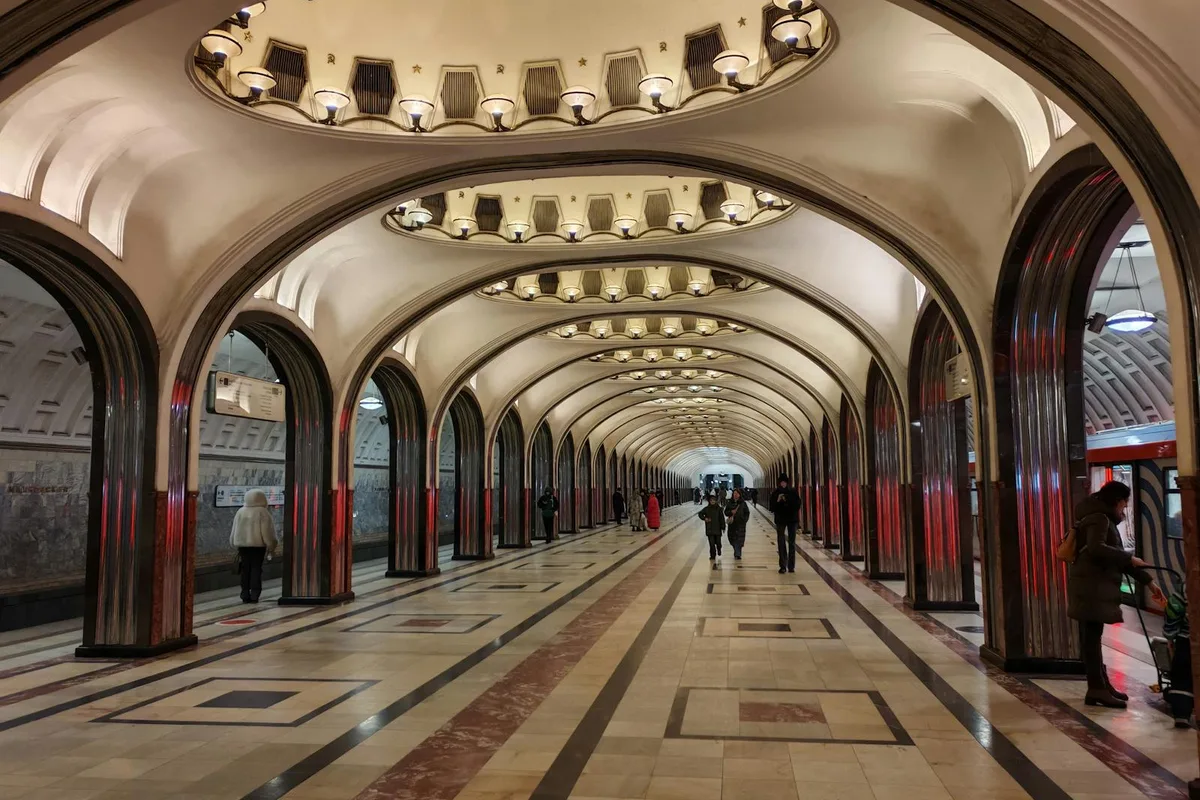
An Art Deco masterpiece from 1938, Mayakovskaya features slender steel columns and 34 ceiling mosaics by Alexander Deineka depicting scenes of Soviet aviation and industry. The station won the Grand Prix at the 1939 New York World's Fair and served as an air-raid shelter during the Second World War.
Ploshchad Revolyutsii (Line 3)
This station contains 76 bronze sculptures by Matvei Manizer, depicting Soviet citizens at work and play. Local superstition holds that rubbing the nose of one particular bronze dog brings good luck, which explains why several canine snouts gleam gold amid the dark patina.
Novoslobodskaya (Line 5, Circle)
Thirty-two stained-glass panels, backlit and framed in brass, line the platform. Designed by Pavel Korin and fabricated in Latvia, they lend the station an almost ecclesiastical atmosphere.
Elektrozavodskaya (Line 3)
Over 300 round ceiling lamps illuminate marble walls and bas-relief panels showing wartime industrial labour. The effect is both monumental and surprisingly warm.
Kiyevskaya (Line 5, Circle)
Ornate mosaic panels celebrate the historical union of Russia and Ukraine, rendered in a style that blends Socialist Realism with something approaching Renaissance grandeur.
A dedicated "metro architecture tour" covering six to eight stations can be completed in two to three hours, including time to photograph each one. Start at Komsomolskaya, ride the Circle Line, and hop off at the stations listed above.
Navigation Apps and Digital Tools
Yandex Metro
The most reliable metro navigation app for Moscow is Yandex Metro (available on iOS and Android). It calculates routes, shows travel times including transfers, and indicates which carriage to board for the fastest exit at your destination. The app works offline once downloaded, which is critical since mobile signal can be patchy in older tunnels.
2GIS
Another excellent option is 2GIS, which combines metro routing with above-ground navigation, showing exits relative to street-level landmarks. It is particularly useful for figuring out which of a station's multiple exits to use.
Moscow Metro Official App
The official app allows Troika top-ups via bank card, shows real-time line status, and provides station information. The interface is available in English, though translations can be rough.
Offline Map Advice
Download an offline metro map image to your phone before arriving. Cell coverage inside stations is generally good thanks to a Wi-Fi network (MT_FREE), but connecting requires a Russian phone number for SMS verification on first use. Some travellers use a local SIM card specifically for this purpose.
Practical Tips for Riding
Escalators
Moscow's metro stations are among the deepest in the world. Park Pobedy station descends 84 metres, making its escalator ride last over three minutes. Stand on the right, walk on the left. This rule is enforced socially with considerable rigour; blocking the left side will earn you sharp words or a firm nudge.
Rush Hour
Between 08:00 and 09:30 and again between 17:30 and 19:30, central stations become extraordinarily crowded. Trains arrive packed. If you are not in a hurry, wait for the next one. Stations like Kitay-Gorod, Taganskaya, and Komsomolskaya are particularly intense during these windows.
Luggage
There are no luggage restrictions, but dragging a large suitcase through rush-hour crowds is inadvisable. If you are heading to or from a railway station with heavy bags, consider a taxi instead, or travel outside peak hours.
Safety
The Moscow Metro is generally very safe, even late at night. Petty pickpocketing occurs occasionally on crowded trains, particularly on Line 1 and Line 2 in the centre. Keep bags closed and phones in inside pockets. Violent crime on the metro is extremely rare.
Etiquette and Unwritten Rules
Russian metro etiquette is unforgiving of those who ignore it. A few norms to observe:
- Give up your seat for elderly passengers, pregnant women, and parents with small children. This is not optional in Russian culture; failing to do so will provoke visible disapproval from other passengers.
- Remove backpacks on crowded trains. Hold them at your feet or in front of you.
- Do not eat or drink on trains. It is technically prohibited and socially unacceptable.
- Keep noise down. Playing music through phone speakers or having loud phone conversations on the train is frowned upon.
- Let passengers exit before boarding. Crowding the doors as a train arrives will not accelerate your journey and may result in a collision with departing passengers who have no intention of yielding.
- Move to the centre of the carriage. Standing by the doors when the train is crowded blocks the flow and irritates regular commuters.
Accessibility
The metro's accessibility record is mixed. Newer stations on the Big Circle Line and MCD lines are equipped with lifts and tactile paving. Many older stations, however, have no lift access, and the depth of some central stations makes them inaccessible to wheelchair users. The Moscow Metro website provides a list of stations with barrier-free access, and the Yandex Metro app can filter routes to use only accessible stations, though this often involves significant detours.
Connecting to Other Transport
The metro integrates with several other networks:
- MCC (Moscow Central Circle): Free transfer within 90 minutes when using a Troika card. Stations are marked on metro maps with a white circle.
- MCD (Moscow Central Diameters): Suburban rail lines that function like additional metro lines. Troika cards work here, with pricing depending on zones.
- Buses and Trams: Troika cards work on all surface transport. Tap on entry.
- Airports: Aeroexpress trains connect Sheremetyevo, Domodedovo, and Vnukovo airports to metro stations (Belorusskaya, Paveletskaya, and Kiyevskaya respectively). A one-way Aeroexpress ticket costs 500 RUB (about 4.85 USD).
A Final Word
The Moscow Metro rewards patience and curiosity. Its signage may be Cyrillic, its escalators may be alarmingly steep, and its rush-hour crowds may be formidable, but it remains one of the great urban transit systems on earth. Learn a dozen station names in Russian, keep your Troika card topped up, and you will move through the city with a speed and ease that no taxi, in Moscow's notorious traffic, can match.